
September 12, 2026 · 7 min read
Fake Culture on Social Media: What Happens Behind the Screen
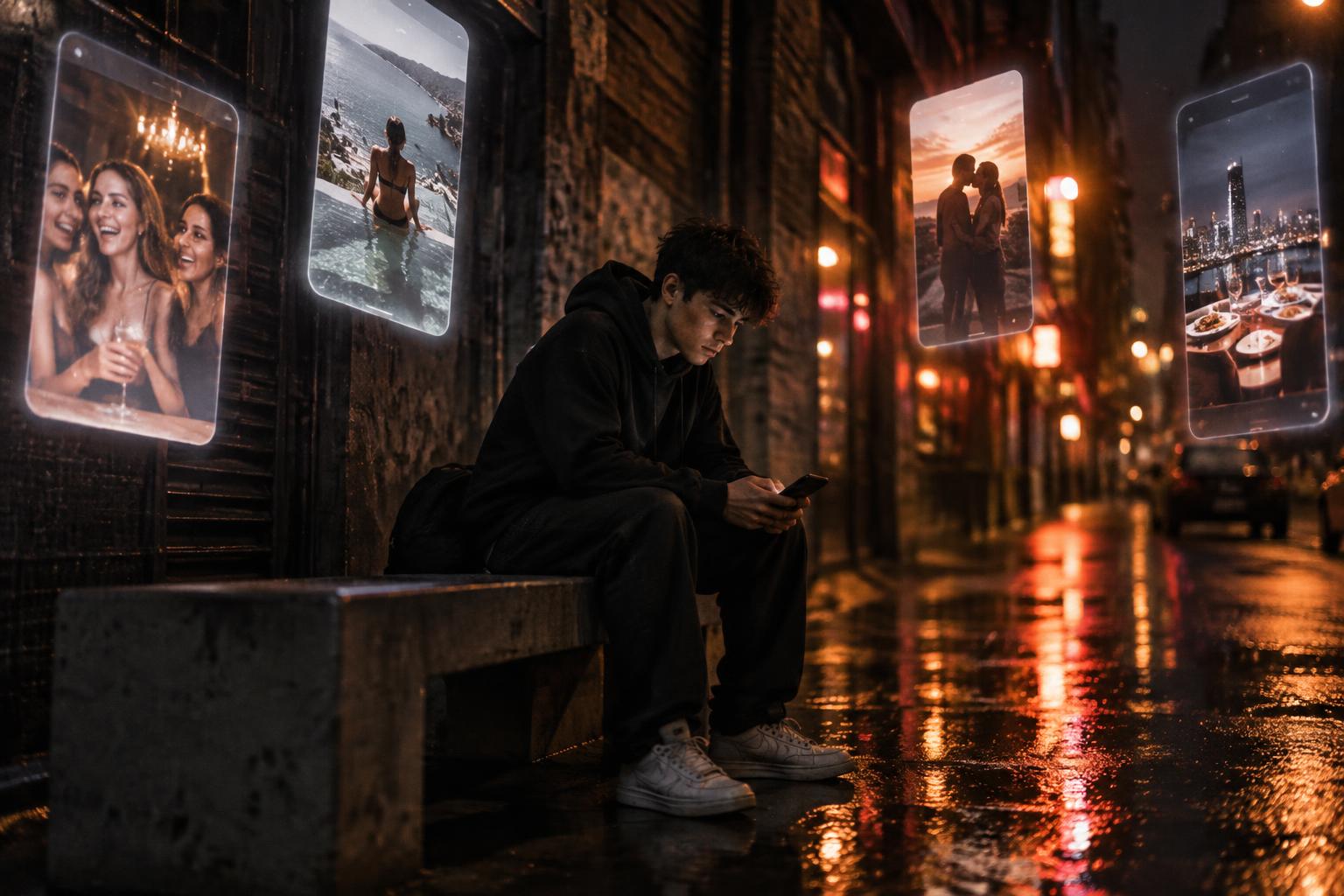
We live in a strange time.
Open almost any social media app and within seconds you can find a parade of apparently perfect lives.
Perfect mornings. Perfect apartments. Perfect relationships. Perfect careers. Perfect bodies. Perfect vacations.
Even the “casual” photo somehow has perfect lighting.
But social media rarely shows an entire life. It shows selected moments from one.
That distinction matters.
Because fake culture on social media isn’t always about someone inventing a completely fictional life. More often, it’s about turning reality into a carefully edited version of itself.
So what happens when the camera turns off?
Fake Culture Doesn’t Always Mean Lying
Calling everything online “fake” would be easy.
It would also be wrong.
The vacation might be real. The promotion might be real. The relationship might be real. The creator laughing into the camera might genuinely be having a great day.
The distortion happens when selected moments begin to look like the whole story.
A beautiful apartment doesn’t show the rent.
A career announcement doesn’t show the months of uncertainty before it.
A perfectly framed morning routine doesn’t show every morning when absolutely nothing goes according to plan.
Social media turns fragments into narratives.
And when enough fragments are polished, repeated, and packaged, reality can start looking suspiciously like branding.
When Authenticity Becomes Part of the Performance
The internet loves authenticity.
So naturally, we learned how to stage that too.
The imperfect selfie.
The “I almost didn’t post this” caption.
The carefully messy bedroom.
The supposedly spontaneous confession filmed from three angles with subtitles.
None of this automatically makes someone dishonest.
But it does reveal something interesting about fake culture online: even authenticity can become an aesthetic.
Being relatable can become part of a personal brand.
Being vulnerable can become content.
Being “unfiltered” can come with excellent lighting.
The line between expressing yourself and performing yourself gets surprisingly blurry when every moment can become a post.
Behind the Screen, Comparison Is Still Real
Even when we understand that social media is selective, comparison doesn’t magically disappear.
We still see the promotion.
The trip.
The relationship announcement.
The transformation.
The person who somehow launched a company, ran a marathon, bought a house, learned Italian, and made homemade sourdough before Tuesday.
Meanwhile, you reheated leftovers.
Again.
The problem isn’t that other people are allowed to share good things.
Of course they are.
The problem begins when everyone else’s selected highlights become the standard against which we measure our ordinary lives.
A feed filled with perfect lives on social media can make normal life look strangely inadequate.
But normal life was never supposed to look like a feed.
When Everything Becomes Content
There’s another side to fake culture that goes beyond perfect vacations and suspiciously photogenic breakfasts.
It happens when every experience starts being evaluated for its potential as content.
A meal becomes a photo opportunity.
A conversation becomes a possible story.
A personal moment becomes a caption.
Even serious events can sometimes be framed through the question: How will this look online?
That doesn’t mean sharing experiences is inherently bad. Social media can connect people, document important moments, spread useful information, and create genuinely meaningful communities.
The issue is what happens when documenting life begins competing with actually experiencing it.
Sometimes the camera adds something.
Sometimes it just needs to stay in the pocket.
Influencers Aren’t the Problem. Influence Is the Question.
It’s easy to turn “influencer” into an insult.
That misses the point.
Influence existed long before Instagram, TikTok, or YouTube. People have always shaped what other people wear, buy, believe, discuss, and care about.
Digital platforms simply made that influence more visible.
And measurable.
Followers. Views. Likes. Shares. Comments.
Suddenly, attention has a dashboard.
But a large audience doesn’t automatically tell us what someone does with that attention.
Some creators educate.
Some entertain.
Some challenge ideas.
Some build communities.
Some sell impossible lifestyles as if success were available in three easy payments.
The interesting question isn’t whether someone has influence.
It’s what they choose to do with it.
Real-fluencer™: A Different Idea of Influence
That question is why FAKE IT created the idea of Real-fluencer™.
Real-fluencer™ is an editorial distinction created by FAKE IT to highlight creators who bring something more human, thoughtful, or genuinely entertaining to the feed.
It is not an official certification, and it isn’t about pretending someone is perfectly authentic every second of every day.
That would be another performance.
The idea is simpler.
Influence can do more than manufacture envy.
A creator can make people laugh without making them feel inadequate.
They can share success without pretending success appeared overnight.
They can talk about difficult subjects without turning every human experience into a personal branding exercise.
They can entertain without selling an imaginary life as the entry fee.
Real-fluencer™ isn’t about finding perfect people.
We’ve already got enough perfection online.
It’s about recognizing a more human way to use influence.
The Best Filter Might Be Critical Thinking
Fake culture works best when we forget that we’re looking at a selection.
A frame.
A moment.
A version.
The goal isn’t to distrust everything you see online or assume everyone is secretly miserable behind the camera.
That would just replace one distortion with another.
Instead, remember the missing context.
The twenty-second video is not the whole day.
The perfect photo is not the whole relationship.
The success announcement is not the whole career.
The personal brand is not the whole person.
Social media can be creative, ridiculous, useful, funny, inspiring, exhausting, and occasionally deeply weird.
FAKE IT exists somewhere inside that contradiction.
Not to tell people to leave the internet.
Just to remind ourselves that visibility isn’t the same thing as reality.
And sometimes the healthiest response to a perfectly staged feed is simply remembering that life has never needed a filter to count.